Showing posts with label Sony Ericsson Phones. Show all posts

Thursday, August 4, 2011

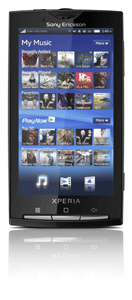
Sony Ericsson X1 Review

In a nutshell: The Sony Ericsson X1 Xperia is a blockbuster mobile. It's a touchscreen phone with the highest resolution display available, plus an optical joystick and a slide-out QWERTY keyboard. It runs Windows Mobile, making it a powerful platform for all sorts of applications, especially email and web browsing. With a 3.2 megapixel camera, Windows Media Player, assisted-GPS, 400 MB memory plus a memory card slot, quadband GSM plus HSDPA and WiFi, it's got the lot when it comes to functionality. Not cheap, not small, but very, very powerful indeed. It just loses one star because the operating system is sometimes slow to respond.
Sony Ericsson X1
Sony Ericsson have been slow to bring out an iPhone basher, but here it is: the Sony Ericsson X1 or Xperia.

The X1 is a touchscreen phone, and it's got one of the biggest and best screens ever seen on a mobile phone. At 3 inches across, it's almost as big as the iPhone 3G's 3.5 inch screen, but here's the thing: whereas the iPhone 3G has 480 x 320 pixels, the Xperia has a massive 800 x 480 pixel resolution: that's 2.5 times as many pixels. Big isn't always better, but when it comes to touchscreen phones, it definitely is. As well as providing a brilliant platform for the touch-operated user interface, the display also offers a superb environment for web browsing, video streaming, photo viewing, etc, etc.
Sony Ericsson X1A lot of thought has gone into the user interface design of the Xperia. As well as the finger-operated touchscreen, there's an optical joystick and a navigation key. To use the optical joystick you brush your finger over the touch-sensitive key to move the mouse pointer on the screen. The navigation key is a conventional 4-way key that can be pressed to select an option. Handwriting recognition with a stylus is available as an additional text-input method. But the X1 holds another secret within: a full slide-out QWERTY keyboard. With the keyboard in position and the display in widescreen landscape mode, the phone resembles a mini-laptop and offers a lot of the functionality of a real laptop - but more of this later. For the moment, we'll just say that with all the different input options available, every user should be able to find a way of working that meets their needs. This is not a difficult phone to use, although its advanced options do present something of a learning curve.

The phone feels very solid too. It uses a premium metal body and feels like it could take some knocks. But the solidity and wealth of features leads to some bulk. It's a big phone, and quite thick too, at 17mm. And it certainly is heavy. In fact it's the heaviest smartphone currently in the shops by our reckoning. At 158g it weighs more than twice as much as the Sony Ericsson W890i for example. It's not a machine for wimps, but it manages to look very nice despite its porkiness. It's available in a choice of Black or Silver, both of which look nice and businesslike.

The user interface is designed around a "Panel interface". Each panel provides an environment customised to a specific activity, such as web browsing, messaging, playing music, etc. We don't think that this is quite as revolutionary as Sony Ericsson claim, but it looks nice, works well and we have no issues with it.

The X1 is a Windows Mobile smartphone. Windows Mobile has matured a lot since its early days and is now a robust and powerful OS. It's also used in the Samsung Omnia, which has proven itself to be a very stable and robust smartphone. Running Windows Mobile offers several advantages. As well as being stable, it's a familiar environment for PC users, and brings a lot of familiar functionality from the desktop to the mobile. For instance, the X1 uses Outlook Mobile as its email application, and it uses Office Mobile to let you view and edit Office attachments. Business folk accessing their corporate mail via an Exchange mailserver can stay synchronised using Exchange ActiveSync. We hesitate to say that the X1 can match a BlackBerry for power and ease-of-use, but it's arguably true. Having said that, it isn't the fastest OS to respond, and can be too complicated for casual users.

Moving on to the camera, we have to say that this is the one area where the X1 disappoints us. A phone this big and this expensive needs the best camera available, but the X1 doesn't have it. Instead of the 5 megapixel monster we hoped for, it has a 3.2 megapixel camera instead. Instead of a xenon flash, the flash is a weaker LED one. The camera does have autofocus and a digital zoom and will take decent snaps in good lighting, but it won't replace a digital camera. This is probably the only fault that we can find with the phone. As well as taking stills, the camera is capable of recording video clips.

The X1 uses a Microsoft product as its media player: Windows Media Player. Not only is this a fully featured and user-friendly media player, but it also integrates seamlessly with Windows Media Player on a PC, so you can manage and synchronise your media libraries without having to mess about with third-party software. The media player handles most common file formats: both audio and video. A very welcome addition is the 3.5mm headphone jack which means that you can plug in third-party headphones (thanks to Paul for pointing this out to us!) You can listen via an optional stereo Bluetooth headset.

One of the features that's now pretty standard amongst high-end smartphones is aGPS, and the X1 doesn't miss out. With GPS you can find your way either using Google Maps, or with the Wayfinder Navigator software that gives turn-by-turn instructions, suitable for use when driving. Unfortunately only a trial version of Wayfinder Navigator is included, with a limited license duration. In any case, a dedicated satnav device like a TomTom will provide a more polished experience for serious satnav use when driving.

As well as the Windows Mobile software and applications that we've already mentioned, there's also a well equipped personal organiser application that includes an alarm clock, a calendar, a calculator, notes and tasks. A benefit of the Windows Mobile platform is that there's also a wealth of third-party apps available for download.

The X1 has a built-in memory of 400 MB, which is sufficient, but not as much as some rivals. Fortunately it can also accept microSD cards - a welcome change from the expensive Memory Stick Micro cards that Sony normally require.

Being a 3G phone equipped with HSDPA, a fast internet connection is possible (when signal strength is good). Combined with the large touchscreen and the optical joystick, this provides a very good environment for the mobile web. In addition, the X1 supports a range of connectivity options - USB, Bluetooth and WLAN - so you can browse the web using a free and fast WiFi connection, provided that you are in a WiFi hotspot or have a WLAN network in your home or office.

The battery life that Sony Ericsson quote for the X1 is exceptionally high - 6 hours talktime and 20 days standby! And it does have a big battery, so this is theoretically possible. However, the large display eats battery power, and when you start using apps, you'll use more power than on standby. So whilst the talktime and standby figures suggest exceptionally good battery life, the real world of clicking, browsing and chatting will reduce performance. Having said that, there's plenty of juice in the battery and you should be able to use it for a few days between charges, unless you live your life on the phone.

We are very impressed with the Xperia X1. We love the huge high resolution touchscreen and the slide-out QWERTY keyboard. We love the Windows Mobile environment and applications (although some of our users are complaining that the phone is too slow.) We love the WiFi. We quite like the memory and the GPS. We're less keen on the size and weight. And we're disappointed by the camera. But on balance, this is a 4 star phone, packed with features galore in a system that seems to be well designed and well tested. In other words, a smartphone that seems to be genuinely smart. We can recommend this one with a fair degreee of confidence.

Alternatives include the Apple iPhone 3G (rubbish camera and various other niggles), the BlackBerry Storm (no WiFi), the Nokia N96 (too many problems) or the Samsung Omnia (smaller screen, but better camera and more memory.) Looks like you're spoilt for choice - both the Samsung Omnia and the Sony Ericsson X1 are great phones, and interestingly they're both Windows Mobile devices.

Friday, July 29, 2011

Sony Ericsson W960i Review

In a nutshell: Sony Ericsson's flagship Walkman phone offers a wealth of features: it's a 3G Symbian SmartPhone with an excellent 3.2 megapixel camera, video recording and video calling, a Walkman music player, an FM radio, web browsing, email, Bluetooth and WLAN connectivity and 8 Gbytes of user memory.
Sony Ericsson W960i
The Sony Ericsson W960i is Sony Ericsson's flagship Walkman phone and is an upgraded version of the W950i. It's a 3G smartphone running the Symbian operating system and has a touchscreen display in addition to a normal keypad. It's a large phone and quite heavy too, yet it retains a classy elegance, and is quite a usable phone. At least the size does enable the LCD display to be large (2.6 inches). The keypad is easy to use (much better than most recent Sony Ericssons) and the touchscreen feature works well. In addition to the touchscreen menus and the numeric keypad, the phone also supports handwriting recognition using a stylus.

The W960i is a Walkman phone, so let's look at the music capabilities first. The first thing to point out is that the W960i has a fixed memory, so you can't add a memory card, but that shouldn't be a problem as the memory is a whopping 8 Gbytes. That's enough to store around 2,000 high quality MP3 tracks, and is more than most rival phones can offer even with memory cards added. The touchscreen interface is at its best when using features like the music player, as you can literally touch the album art of a song to select it. It makes the music player even easier to use than an iPod Classic. With the Walkman 3 music player you can play, rewind, fast forward, equalise, shuffle tracks and create playlists. There's a dedicated key for starting the Walkman music player. Software is supplied for transferring music from your PC and for ripping tracks off CD's. A stereo headset is supplied with the phone, and you can optionally purchase a Bluetooth headset to listen to your music wirelessly. In addition to the music player, the W960i has a built-in FM radio with RDS.

The predecessor to the W960i came without a camera, which many thought was a major omission. Sony Ericsson have fully taken this on board and the W960i has a powerful camera: 3.2 megapixels with autofocus and an LED flash. It lacks the more powerful xenon flash found on Sony Ericsson's flagship Cyber-Shot phone, the W850i, but is nevertheless one of the better camera phones on the market. The camera can also take video clips, and 3G video calling is available too.

The large screen and always-on 3G connectivity make mobile web browsing and email a reality. The Opera web browser is supplied pre-installed, and a document viewer and editor is available for working with attachments. These features combined with the touchscreen user interface make the W960i into a powerful business tool that can start to compete with the likes of Blackberry. In fact, Blackberry Connect can be installed, enabling push email and contact synchronisation. As the phone runs Symbian, there are literally thousands of applications available for download.

The W960i is a very powerful device with outstanding music capabilities and a good all-rounder in other respects. It would have been nice to see a HSDPA-enabled implementation of 3G, but the ability to connect to Wi-Fi compensates for this to some extent. It would have been nice to have quadband too. It also has a tendency (like all Symbian phones) to sometimes be a little slow and shaky, especially when running applications. Nevertheless, the W960i is in many ways outstanding, and it's only because it's so good that these issues are worth pointing out. Possible alternatives include the LG Viewty, Nokia N95 8GB, Nokia N81 and maybe even the Apple iPhone.

Sony Ericsson K850i Review

In a nutshell: The eagerly awaited Sony Ericsson K850i should have been the best camera phone ever, with a 5 megapixel camera, xenon flash, autofocus & automatic lens cover. But problems with the keypad, camera and firmware mean that we can't in all honesty recommend it. Choose the Sony Ericsson C902 instead.
Sony Ericsson K850i
Sony Ericsson's Cyber-Shot™ range of phones have been a massive hit. The K800i quickly gained a reputation as the best camera phone on the market; the K810i changed the styling but not much else; the K850i is the one that moves the technology forward to the next stage, with its 5 megapixel camera and high-speed 3G (HSDPA).

First, the looks. Looks like Sony Ericsson were determined to restyle the phone. It's definitely less bricklike in its looks, and it's slimmed down a lot since the K800i days, which is a welcome change. It has a funky blue gizmo on the front and side, which you may or may not like (tip - buy the "Velvet Blue" model pictured and not the hideous "Luminous Green" option.) Now a word about the keypad design. We're really happy to see that Sony Ericsson have finally dumped the horrible joystick that marred both the K800i and K810i but whose idea was it to position the navigation pad in the middle of the keypad so that it overlaps the buttons? And why the small buttons when everyone knows that bigger is better? Grr! And why have Sony Ericsson introduced touch-sensitive keys that everyone hates? We have to say it: we hate the keypad!

OK, so let's talk about the camera. This is tricky. On paper, the K850i is clearly way ahead of the competition. It has high quality Cyber-Shot optics. It has a whopping 5 megapixel resolution. It has a xenon flash (superior to the LED flashes on other camera phones). It has autofocus (to keep your subject sharp) and an automatic lens cover that fixes the problem that the K800i had with the lens cover opening by itself. The camera also has a BestPic™ feature which can automatically take nine photos in a second, so that you can then choose which one to keep. There's also a picture stabiliser, which helps to reduce camera shake. A new switch on the side of the phone lets you switch easily between camera modes, much like in a real digital camera. Used carefully, the K850i can take pictures that improve on the K800i and are even better than the Nokia N95.

Why then is the camera the thing that most of our user reviews have complained about most? Read the reviews below for yourself: there are a lot of disappointed Sony Ericsson fans who have upgraded to the K850i only to find that they end up with badly exposed or totally black pictures. The problem, we suspect, lies with the flash. The design of the flash makes it very easy to place your fingers in the wrong place and completely mess up the flash, resulting in a dark picture. To avoid this you need to hold the edge of the phone (not the best way to hold a camera steady). But we suspect that there's more than this behind the problem, and that the flash itself may have fundamental problems. Whether these can be fixed by firmware releases, we don't know, but for us, a product whose unique selling point is potentially flawed is a fundamentally flawed product. For this reason, we'd recommend that you stick with the K800i or K810i or try the Nokia N95.

Anyway, moving on to the phone's other features, the display is a very high quality TFT ultra-high resolution screen and is very large at 2.4 inches. The media player is fully featured, despite not being a Walkman phone. There's also an FM radio equipped with RDS. MP3 and AC ringtones are supported.

The K850i is also the first of the Cyber-Shots to support accelerated 3G (HSDPA), which enables you to access the web and download files at broadband speeds. Nice to see that feature available to Sony Ericsson users at last. As this is a 3G phone, video calling is enabled too, and the video quality is pretty good, using a front-facing second camera.

Connectivity is excellent with full support for Bluetooth and USB, so it's possible to listen to music on a wireless headset and making it very easy to transfer music files between phone and PC. Battery life is pretty good, with a quite high powered battery to power the big screen and 3G. The built-in memory is just 40 Mbytes, but this is expandable to 4 Gbytes with a Memory Stick Micro™, and there's also support for the microSD™ format cards too.

So, in conclusion, the K850i is a 5 star phone that fails to live up to expectation. The flawed keypad design and problems that people are experiencing with the camera mean that we cannot recommend the K850i. Choose the Sony Ericsson C902 instead.

Sunday, July 24, 2011

Sony Ericsson Spiro Review

In a nutshell: The best features of the Spiro are its Walkman player and FM radio. Other than that, it doesn't offer a lot, and is probably best avoided.
The most popular phones may all be touchscreen smartphones, but not everyone can splash out that kind of money on a mobile. Besides, if all you need to do is make calls, send texts, listen to music and connect to your mates on Facebook, you can do all that for under fifty quid. And so the Sony Ericsson Spiro could possibly be your next phone. It does all the aforementioned, plus it has Bluetooth, a basic camera and is cute and compact into the bargain.
Sony Ericsson Spiro
The trouble is, Sony Ericsson have cut rather a lot of corners to fit the pocket-sized Spiro into a pocket-sized budget. While we're not expecting GPS or Wi-Fi at this price level, we are, frankly, hoping for more memory and triband operation at least. The memory in particular, at just 5 MB, is pitiful, making a microSD memory card an essential purchase and therefore inflating the price.

There's one thing that the Spiro does well (in addition to making calls and sending texts), and that's play music. With a Walkman 4.0 player, an FM radio with RDS, and a 3.5mm headphone jack, there's nothing to complain about at all. Apart from the lack of memory, which we've already complained about.

The other thing that the Spiro does is access Facebook and Twitter. But it doesn't do these well. With no 3G to provide fast internet access, and just a tiny little screen available, you'd be better off forgetting about these features. Forget the web browser too - it's rubbish.

And we mustn't forget to factor in the fact that half the claimed features don't work reliably and the phone has a tendency to keep breaking down.

We can't recommend the Spiro. Although it's cheap, it still doesn't work very well as a basic phone.

Sony Ericsson Xperia Arc Review

In a nutshell: The Sony Ericsson Arc is a contender for the best Sony Ericsson phone ever, and best Android phone too. It's a stunningly beautiful device with a gracefully curved back and is the slimmest smartphone on the market. Its specs are a match for any other phone in existence too - the latest version of Android (2.3), 4.2 inch screen with Sony's BRAVIA TV technology for perfect video playback, 8.1 megapixel camera with Sony's brand new Exmor R™ CMOS sensor, HD video recording, 1GHz Snapdragon processor, HDMI output. It's an incredible phone that can't fail to impress. Available in Midnight Blue (Black) or Misty Silver.
Sony Ericsson Xperia Arc
We've been looking forward to reviewing the Arc ever since it was first announced, so please excuse us for a moment as we shout "Wooooooooow!" Thank you, that's better. The Arc is a stunner. It's a beaut. It's gorgeous. It's like the Sony Ericsson X10 after Gok Wan has given it a makeover. It's easily Sony Ericsson's best Android phone. Wait ... is it Sony Ericsson's best phone ever? It could be.

OK, let's calm down, get some facts. The starting point for the Arc is of course the X10 Android phone from 2010. Sony Ericsson have taken what was a very powerful phone, learnt some hard lessons and rebuilt the thing from scratch, keeping what was good, throwing away what was bad, and giving their design department free reign to go mad. So at first glance the Arc looks quite like the X10, but it's been given a curved back and slimmed down to an incredible 8.7mm at its thinnest point. That's slimmer than the Google Nexus S. Slimmer than the Samsung Galaxy S. Slimmer even than the iPhone 4. It's the slimmest smartphone on the market. And it's curvy too. Hence its name. Arc.

Slim, curvy, sexy. It's a gorgeous phone to look at and to hold. But maybe there's more. Let's turn it on now and see what happens. The screen is incredible. At 4.2 inches, it's the second largest screen currently available, just a whisker behind the 4.3 inch display of the HTC Desire HD and with an even higher 480 x 854 pixel resolution. It's been upgraded to 16 million colours too. Sony's BRAVIA TV technology has been added too, but we won't see the difference that makes until we watch some video.

The user interface is great. It's Android plus Sony Ericsson's Timescape enhancement. Timescape has evolved since it first appeared on the Xperia X10 and for the better, with more customisation available, and much less intrusive behaviour. And unlike previous Android phones from Sony Ericsson, the Arc is bang up to date with the latest Gingerbread 2.3 release of Android. We can't rave about this enough. Not only is it a supremely responsive and intuitive user interface, but it's both simple to use and incredibly powerful, with seamless integration of facebook, twitter, email, calendars and contacts, plus over 100,000 apps available to download from Android Market.

The camera has been upgraded and is now one of the very best cameras available on a mobile phone, probably second only to the Nokia N8. With a resolution of 8.1 megapixels, an enhanced CMOS sensor with improved low-lighting sensitivity, touch-operated autofocus, LED flash, plus a host of added extras such as face recognition, smile detection, image stabiliser and red-eye reduction, it uses the best of Sony's digital camera technology. We honestly don't know how they've fitted a camera of this quality into such a slim device. The camera can also record video at HD 720p resolution, with a video light and video stabilisation.

One of the highlights on any Android phone is GPS with Google Maps, and it's here on the Arc with Google Latitude (share your location with your friends) and Street View. And it works brilliantly.

The media player is fully featured and plays video very smoothly indeed, thanks in part to the super-fast processor powering the device, but also to Sony's BRAVIA television magic. There's also an FM radio with RDS. Sound quality through the stereo speakers is good and a 3.5mm audio jack lets you plug in your own choice of headphones.

When it comes to connectivity, the Arc has the lot. Wi-Fi, Bluetooth, USB and even HDMI for connecting to a HD-Ready TV. It also has a new technology called ANT+ which lets you connect wirelessly to a variety of health and fitness products. The phone has fast 3G data access too, and you can easily sync it with your Google account, facebook, twitter and your Microsoft Exchange email server.

The web browser is very ease to use. It's nice and responsive thanks to the fast processor and the HSDPA / Wi-Fi data access, and you can use pinch-and-zoom to view your web pages better. Flash video is supported and you can watch youtube clips.

Battery life is often a challenge for smartphones, especially ones with large TFT screens. The Arc is equipped with a monster 1500mAh battery and seems to manage pretty well however. Heavy users will probably have to charge every other day - lighter users should get quite a few days between charges.

Another bonus feature for the Arc is the Noise Shield. This uses a secondary microphone on the back of the phone to pick up and cancel ambient noise, so the person you're talking to can hear you better.

So far the Arc has ticked every possible box, so it's irritating that Sony Ericsson have only given the phone a paltry 320MB of onboard memory. Sure, there's an 8GB card included and this can be expanded up to 32GB, but that onboard memory is going to be an annoyance.

We think that this could prove to be a huge hit for Sony Ericsson. It's up there with the HTC Desire HD, Google Nexus S and the Samsung Galaxy S as top Android phone so far, and it ticks virtually every box as well as looking absolutely stunning. It's priced the same as those other phones too. It looks to us like Sony Ericsson have turned a corner with the Arc. For the first time they've released an Android phone with the current version of Android (Gingerbread) with a promise to update to Honeycomb when that is released. They've put cutting edge technology into a gorgeous wrapper and delivered it at a competitive price. The Arc is one of the very best phones to be released so far in 2011.

Sony Ericsson Xperia Play Review

In a nutshell: The Sony Ericsson Play is the first ever Playstation phone. The Play takes mobile gaming to a new plane, with Playstation-like controls, plus motion control and gesture control using the phone's front-facing video camera! It's also a high-powered smartphone running Android Gingerbread. The hardware is top notch too, with a giant 4 inch display, 5.1 megapixel camera, assisted GPS with Google Maps and Street View and a DLNA connection so you can plug the phone into a HD-ready TV. Available in Black or White.
Sony Ericsson Xperia Play
Is it a phone? Is it a PlayStation? No, it's the PlayStation phone, properly known as the Sony Ericsson Xperia Play.

At first, it seems to be just another touchscreen smartphone. A rather heavy one, and a little thicker than most. But slide it open and it turns into a PlayStation game controller, with access to a range of 3D games. It was a concept just waiting to happen - all it needed was a processor fast enough to power 3D games (1GHz Snapdragon processor and Adreno 205 GPU) and a big 4 inch screen and voila!
Sony Ericsson Xperia Play
The Sony Xperia Play is built on the Android operating system and uses the latest version of Android, called Gingerbread. This means that you get a fast, powerful and user friendly operating system, with power features and access to over 100,000 downloadable apps. Sony Ericsson have been releasing Android phones for over a year and have brought a number of novel concept phones to the market, including the tiny Xperia X10 Mini and the futuristic-looking Xperia Arc, but the Xperia Play is probably the most original concept phone so far. The implementation of Android on the Play is similar to that on the Arc, with five home screens plus Sony Ericsson's Timescape enhancement providing seamless integration of facebook, twitter, email, calendars and contacts.

To transform your phone into a games console, you simply turn it into landscape mode, flip open the slide and a genuine PlayStation game controller is unveiled, complete with D-pad and face buttons (circle, square, triangle and cross). The buttons work well although the touch-sensitive thumbpads in the centre are perhaps less responsive. There's an accelerometer to sense which way up you're holding the device, and you can touch the screen to make things happen too. Does this tactile "in your hands" experience compensate for the fact that you've only got 4 inches of screen and less than HD resolution? Well, the success of other portable games consoles indicates a clear "yes" answer to that, so the question really should be, "how does the Xperia Play experience measure up to the 3DS experience?" The truth has to be that a dedicated portable games console will give you a better experience, as it's built to do just that one job. But there's still plenty of enjoyment to be had from the Xperia Play.

In addition to the gaming features, the Xperia Play comes with a 5 megapixel camera with flash and autofocus. At this price point we might have expected an 8 megapixel camera, but we can't have everything. The Play also has a front-mounted VGA video camera.

The Play has assisted GPS of course, with Google Maps pre-installed. This is the very latest version of Google Maps, with plenty of extra features to play with, such as Street View and Latitude (share your location with your friends). It's remarkable how polished the system is and how well it works on a mobile device.

The Play is a fully-featured media machine too, with a media player capable of handling playlists and album art, plus an FM radio with RDS. Sound quality from the stereo speakers is really quite good for a phone, and you can plug in a proper set of headphones with the 3.5mm headphone jack.

A feature first seen on the Arc and also present on the Play is the Noise Shield. This uses a secondary microphone at the back of the phone to pick up and cancel ambient noise, so the person you're talking to can hear you better.

Connectivity is outstanding, with 3G HSPA and Wi-Fi for fast internet access, Bluetooth wireless access and USB. There's also an HDMI port, so you can plug your phone into a HD Ready TV and play your games large! Web browsing on the Play is a good experience, with pages loading quickly and rendered well. The browser responds well to the touch, whether you're scrolling with your finger or using two fingers to pinch-and-zoom. Flash video is supported and you can watch youtube clips.

The built-in memory of 400MB is less than we'd have liked, with many other high-end phones having 8GB or more, but you can augment this with a microSD memory card up to 32GB. An 8GB card is included in the sales package.

Battery life. Hmmm. The Xperia Play has a 1500mAh battery, which is the largest you'll find on a mobile phone at present. But it needs it! Sony Ericsson are claiming 5.5 hours of game play, but if you plan to make calls and do other stuff you'll have less time playing games. But it's only a mobile device, so this is perhaps the best anyone could realistically expect. Just remember to charge your phone every night and you should be OK.

Finally, let's talk money. The Xperia Play is one of the most expensive phones on the market, more expensive than the Sony Ericsson Xperia Arc or the Google Nexus S for instance. For this kind of money you could get a less expensive Android phone plus a Nintendo 3DS. You'd have a better phone and a better games console. Sure, you'd have to carry two devices instead of one, but that's the way life is sometimes. It's perhaps inevitable that combining two devices in one leads to compromise. There are certainly compromises here. The games controller isn't as polished as a dedicated one (3DS for instance) and as a phone the Xperia Play is rather large and very heavy. It's very expensive too. We'd recommend it, but with reservations.

Sony Ericsson Xperia X10 Review

In a nutshell: The Sony Ericsson X10 is a superphone! It's a touchscreen smartphone running Google's Android operating system and layered with Sony Ericsson's unique user interface specially designed for the phone. It's supremely powerful, but very easy to use too. Tech specs include an absolutely enormous 4 inch screen, an 8.1 megapixel camera, GPS, HSPA, 1GB memory plus an 8GB memory card, and a monster battery.
Sony Ericsson Xperia X10
The X10 is Sony Ericsson's superphone and is one of the most anticipated handsets of 2010. What does it do? It does everything! We recently reviewed the HTC Desire - another Android phone - and described it as virtually the perfect phone. Well, The X10 is a phone that can rival the Desire. Android is certainly the operating system of choice if you want the very best that's available in 2010.

Sony Ericsson were slow to enter the touchscreen market, dipping their toe in cautiously with the Xperia X1 (running Windows Mobile) and the Satio (running Symbian). We had the impression of a company desperately in search of a strategy. But we needn't have worried, because behind the scenes they've been busy working on their own implementation of the Android operating system. As regular readers of mobile-phones-uk.org.uk will have spotted, Android has become our new favourite operating system, now that the early adopters who bought the first Android phones have found all the bugs and the Google guys have graciously fixed them. Android is now a smooth and powerful OS, and the Android Market is shaping up nicely, so there will be loads of apps available for the X10.

What SE have cleverly done is to layer the Android OS with their own user interface, a bit like HTC have done with HTC Sense. So what you see when you power up the X1 is interface screens such as Timescape, which gathers together all your communications for any one of your contacts. Text messages, emails, Facebook, Twitter, and even photos are all gathered together, so there's no need to open apps to see what's going on. Similarly, Mediascape brings together all your music, photos and videos. The Infinite virtual button is used to gather together all the related information for a contact or media type. The whole system comes together and works very well. It's very much like a mini computer, but geared to mobile use.

Let's get physical now. The X10's a big machine, that's for sure. But it's the same weight as the iPhone 3G S and only a millimetre or so longer. Yet it's got a screen that puts the iPhone to shame. Yep, you read that right. The X10 has a 4 inch screen, compared with the 3.5 inches of the iPhone, and almost three times the number of pixels. It's bigger than the screen on the HTC Desire and even the Nokia N900 internet tablet for that matter! We think: wow! When it comes to touchscreens, bigger is always better. It makes the virtual keyboard so easy to use you don't care that it's virtual. And the X10 supports handwriting recognition too, if you like that. The screen is capacitative, which makes it very responsive to the touch.

In fact a bigger screen is better for all kinds of things. It's certainly better for viewing photos taken with the impressive 8.1 megapixel camera. Naturally the camera has autofocus, flash and a digital zoom. It also has a smart face recognition feature which not only recognises faces when using the camera, but also recognises faces in any pictures stored on the phone. If you name a person in one of your photos, the X10 can then recognise that person in other photos! By touching the person's face, you can access contact details and other information for that person. If you're thinking that this kind of face recognition is a hard problem for a computer and that it might not have a 100% success rate, you'd be right! But it works surprisingly well most of the time.

The big screen also makes web browsing and apps like Facebook work like a dream. And with internet access via HSPA and WiFi you have a fast always-on connection to the web.

The X10 isn't Walkman branded, but fear not because it has an outstanding music player, with full support for all the features you'd expect, including a 3.5mm audio jack so you can plug in your own stereo headphones. You can also use Bluetooth stereo headphones if you prefer.

aGPS is present too, as you'd expect from a device of this type. It's integrated with Google Maps, and comes with a limited license for the Wisepilot Turn-by-Turn navigation software. As we've already noted for other applications, the enormous screen really makes the most of this feature.

A machine with this much functionality needs some heavy-duty hardware to power it, and the X10's got what it takes. The processor is the Qualcomm 1GHz Snapdragon processor as used on the HTC Desire and one of the fastest processors available. The phone has 1GB of memory built in and is supplied with an 8GB microSD card too. This is expandable to 16GB. The battery has a huge 1500 mAh capacity, which is about as big as it gets in the mobile world.

Is there anything missing from the Xperia X10? Well, yes a few things. There's no video calling and no FM radio. Our users tell us they don't use video calling, and you can access radio stations over the internet, provided you have an unlimited data package in your contract. Also the version of Android used is 1.6, not the latest 2.1, so the software is looking quite outdated now.

Sony Ericsson Xperia X10 Mini Review

In a nutshell: The Sony Ericsson X10 Mini is a half-size version of the original X10. It's an ultra-compact smartphone running Android and with impressive features such as a 5 megapixel camera with autofocus and flash, aGPS with Google Maps, a fast processor, support for 16GB of memory and a good battery life. Connectivity excels with WiFi and HSPA. But the small screen size presents a challenge.
Sony Ericsson Xperia X10 Mini
The original Sony Ericsson Xperia X10 is an amazing Android phone, but it does suffer from being rather large. So a mini version has got to be a good thing. Hasn't it? Let's take a closer look and see what the X10 Mini can do.

Well, the styling of the X10 Mini is exactly the same as its big brother, including the three silver buttons below the screen. But it's a much smaller handset and weighs in at a svelte 88g, making it very compact and lightweight indeed. It's possibly the lightest and most compact smartphone currently on the market. In fact, it's tiny even compared to non-smartphones. When Sony Ericsson say Mini, they certainly mean it!

But the small size comes with a price - a small screen. It's just 2.55 inches in size, making it perhaps the smallest touchscreen that we've ever used. Oh dear, this doesn't help make the phone easy to use. Although the screen has a decent resolution of 240 x 320 pixels, and is bright and sharp, it's just physically too small to fit enough on the screen. There isn't even enough room for a virtual QWERTY keyboard, but the icons and buttons are big enough to press and the very responsive capacitive screen certainly helps a lot. Sony Ericsson's interface screens help too, such as Timescape which brings together Facebook updates, tweets, texts and missed calls so you don't have to keep moving between apps. The facebook and twitter apps work pretty well. The screen is laid out logically, with icons in the four corners giving you one-touch access to user-defined functions such as music, camera, contacts, etc. You can easily customise the layout and add widgets to your screens, although there isn't room for many. The combination of Android and Sony Ericsson's customisations certainly make a lot out of the small screen real estate, but we're left wanting more. You'll probably struggle even more on a bright, sunny day. The small screen also tends to make the phone feel a bit like a toy. Some users may also find it rather small to hold when making phone calls. Still, this is the inevitable result of making the device physically small, so you have to balance the advantages against the disadvantages.

What else is in this super-compact smartphone? Well, there's a 5 megapixel camera with autofocus and flash. The camera can record video at VGA resolution with a video light, but there's no video calling. The X10 Mini includes an excellent media player, with a 3.5mm audio jack so you can plug in your own headphones. There's also support for Bluetooth stereo headphones. You can look up a song on Google or youtube with a single click. An FM radio with RDS is included too. TrackID (find out the name of a song) and PlayNow (download ringtones, etc) are available too.

aGPS is here, with full support for Google Maps (including Street View) and geo-tagging of photos. A demo version of WisePilot Turn-by-Turn navigation software is included, although we wouldn't recommend the X10 Mini for in-car navigation due to the small screen size.

The built-in memory of 128MB is small for a smartphone, but you can add microSD memory cards of up to 16GB. A 2GB card is included in the sales package.

Connectivity is good, with WiFi, Bluetooth, USB and a 3.5mm audio jack, although Bluetooth file transfer is a challenge. The phone also offers fast internet access over 3G with HSPA giving maximum download speeds of 7.2 Mbps. The phone syncs with your PC, including syncing your email with Microsoft® Exchange email server, although the Android system really wants desperately to sync with Gmail.

Web browsing isn't awful, despite the small screen, although you'll find yourself scrolling up and down and zooming in and out rather too much for comfort. Zooming isn't that easy, as it involves clicking zoom buttons, as there's no pinch-to-zoom capability. There's no Flash support either, although on the positive side YouTube videos are fully supported via a dedicated app.

Battery performance isn't too bad. The small screen size helps to conserve juice, and you should get a couple of days' use between charges - better than the HTC Desire we think. Be aware though that the battery is not replaceable. The processor is a 600 MHz Qualcomm CPU, which isn't the fastest available, but is certainly fast enough for the screen size. You'll find that the X10 Mini responds eagerly to your fingers.

We mentioned in our Xperia X10 review that Sony Ericsson have so far only released Android 1.6 on the Xperia phones. An upgrade to version 2.1 has now been made available. Android is a powerful operating system and the number of useful apps that are available to download free is starting to rival that of the iPhone.

To sum up, the X10 Mini is a super-compact smartphone that gets 5 stars for looks and "cute" appeal, and packs in plenty of high-spec features. However, we found ourselves wishing that the device was actually just a but bigger so it could fit in a larger display. It's a shame that SE couldn't manage to release Android 2.1 at launch, and we do feel that the phone's at the top limit of what we'd be prepared to pay. Still, on upgrade it's free and if you're prepared to make the necessary compromises in return for such a compact phone, the X10 Mini is a good choice.

The new Sony Ericsson Xperia X10 Mini Pro is the same phone but with a slide-out QWERTY keyboard.

Sony Ericsson Xperia X10 Mini Pro Review

In a nutshell: The Sony Ericsson X10 Mini Pro has everything that the original X10 Mini has, plus a slide-out physical keyboard. It's an ultra-compact smartphone running Google's Android OS, with a 5 megapixel camera with autofocus and flash, aGPS with Google Maps, a fast processor and support for 16GB of memory. Connectivity includes WiFi and HSPA. But the small screen size, poor battery life and old version of Android are a disappointment.
Sony Ericsson Xperia X10 Mini Pro
A strong contender for the mobile phone with the longest name ever, the Sony Ericsson Xperia X10 Mini Pro was released in the UK at the start of July 2010. We've really been looking forward to the release of the X10 Mini Pro, as we have a soft spot for phones with real keyboards. So, does the Pro deliver on its promise?

The X10 Mini Pro is almost exactly the same as the Sony Ericsson Xperia X10 Mini, except that it has a slide-out QWERTY keyboard. This adds a little to the weight of the phone, although it's by no means heavy. Amazingly, Sony Ericsson have managed to sneak the keyboard into the design without compromising any of the phone's hardware, and adding only a millimetre to its thickness. Astonishing! It's not a perfect keyboard, with a somewhat dead feel about it, but the keys are a good size and they're well spaced out. After an hour of use, you get used to the feel and can type quickly.

Apart from the keyboard, it's basically the same phone as the X10 Mini, so read our review of that phone for more insight. We like the keyboard very much, but we dislike the poor battery life, small screen, less than perfect reception and general clunkiness of the software.
 
Free Website templateswww.seodesign.usFree Flash TemplatesRiad In FezFree joomla templatesAgence Web MarocMusic Videos OnlineFree Wordpress Themes Templatesfreethemes4all.comFree Blog TemplatesLast NewsFree CMS TemplatesFree CSS TemplatesSoccer Videos OnlineFree Wordpress ThemesFree Web Templates